What is a Multiactor Forum (MAF)? Good question! Listen to Raffaele explaining how you can bee involved, even become asked about your option! How you can influence such a big project. Our MAF group is with around 250 stakeholders. Feel free to join, sign up on this mail: maf@beeguards.eu
Queen caging is a crucial part of the BeeGuards project. Here are some nice articles already done by several team members of BeeGuards. Climate changes results in shorter and shorter winters and brood breaks seems to disappear more or less in many countries. This means varroa and virus not in control! Many inventions have been developed to create brood breaks. Queen caging has become popular. But read and see her. The RINGING of a queen. Have look on these nice publications on comparing caging and ringing. All done by BeeGuards members. https://www.tandfonline.com/doi/full/10.1080/0005772X.2023.2263285 Read more about ringing in this publication! Queen Ringing – An Alternative Method for Inducing Brood Interruption. https://doi.org/10.1080/0005772X.2023.2263285 and enjoy this how to video: https://www.youtube.com/watch?v=eBAxwKE8NQo
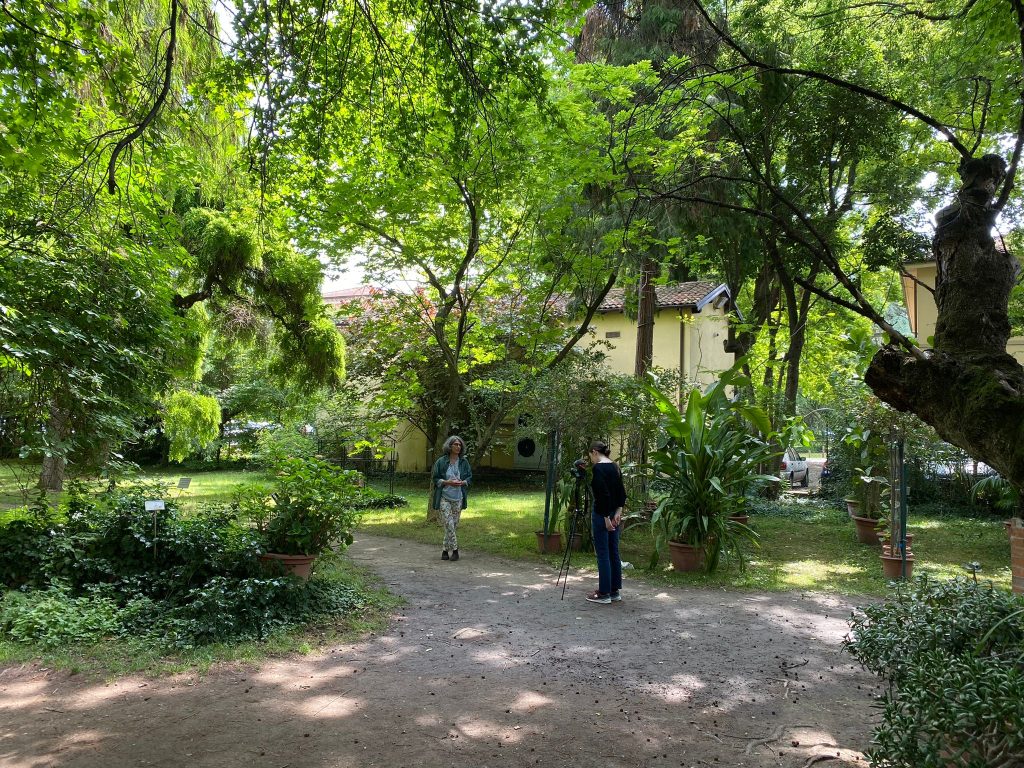
One of the BeeGuards mating stations is placed in the Botanical Garden of Bologna. A very exciting place in regard to mating honey bee queens. The city center offers an extremely low commercial honey bee density and was thus found suitable for controlled mating necessary to implement the work program of WP2.
The Botanical Garden and Herbarium of the University of Bologna are open to the public and regularly host school children as well as university students.
And being in a public place, it is important to be open minded and share your project and knowledge. Visitors are curious and want to know what is going on in the garden.
Therefore, very nice information posters have been produced. Here presented by Cecilia Costa, BeeGuards coordinator, standing proudly next to the overview poster.
Another poster explains the honey bee mating biology and the importance of the bee queen.
On one of our pictures, you can see the mating nucs, where the virgin queens are hosted and mated.
Our project has public awareness, and already the first interview with the Botanical Garden’s Professor Marta Galloni has taken place.
We have a very nice setup in the heart of Bologna with access to the public. Nice job by CREA and BeeSources.
Read the Open Access Article in Bee World on BeeGuards written by Cecilia Costa, Aleksandar Uzunov on behalf of the BeeGuards consortium. The Article provides the background, why research on this level on the investigated topics is necessary. It also presents the research on the BeeGuards “Hive-Five”: 1. individual honey bees, 2. the colony, 3. the beekeeper, 4., the agro-ecosystem and finally, 5. society. We hope that this article answers all your questions on BeeGuards, if not, you can a) sign up for our newsletter, b) join our Multi-Actor-Forum (contact maf@beeguards.eu) c) become involved as citizen scientist, or d) follow us on social media and ask us a question. Whoopi 09
BeeGuards “WP2 – Innovative Breeding” is about to enter its pivotal phase for the current year, as the honey bee mating season is approaching in most European countries; in this episode, we will feature the interview with Raffaele Dall’Olio (BeeSources) who is running the study in Italy in collaboration with CREA. As Italy is the southernmost country involved in WP2, don’t be surprised when Raffaele will tell you that both ‘conventional’ and ‘innovative’ mating stations are already open!
Spent 15 min with Cecilia Costas to understand BeeGuards at her presentation at the 3rd International Event on bee health towards sustainable apiculture, Tenuta Presidenziale di Castelporziano on the 17th May.
The BeeGuards work package dedicated to science-society interactions seeks innovative ways of disseminating knowledge to beekeepers? Will artificial intelligence play a major role in the future? Our project partners from University of Graz participated in the COLOSS B-Rap AI challenge. You can read the paper here: https://www.tandfonline.com/…/10…/0005772X.2024.2348305
An innovative method to control Varroa destructor in honey bee colonies are brood interruptions reached by caging the queen. There are several options of queen cages available out there, but University of Graz shows us in a short video how to build such a cage from available materials.